 The IAU therefore resolves that planets and other bodies in our Solar System be defined into three distinct categories in the following way:
(1) A planet is a celestial body that (a) is in orbit around the Sun, (b) has sufficient mass for its self-gravity to overcome rigid body forces so that it assumes a hydrostatic equilibrium (nearly round) shape, and (c) has cleared the neighbourhood around its orbit.
(2) A dwarf planet is a celestial body that (a) is in orbit around the Sun, (b) has sufficient mass for its self-gravity to overcome rigid body forces so that it assumes a hydrostatic equilibrium (nearly round) shape, (c) has not cleared the neighbourhood around its orbit, and (d) is not a satellite.
(3) All other objects orbiting the Sun shall be referred to collectively as "Small Solar System Bodies".
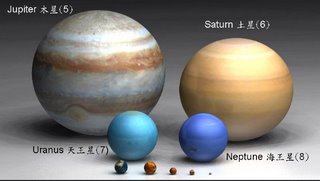
The eight planets are: Mercury, Venus, Earth, Mars, Jupiter, Saturn, Uranus, and Neptune.Insert the word "classical" before the word "planet"
previous define:
 (1) the object must be in orbit around a star, while not being itself a star.
 (2) the object must be large enough (or more technically correct, massive enough) for its own gravity to pull it into a nearly spherical shape. The shape of objects with mass above 5 x 10²⁰ kg and diameter greater than 800 km would normally be determined by self-gravity, but all borderline cases would have to be established by observation.
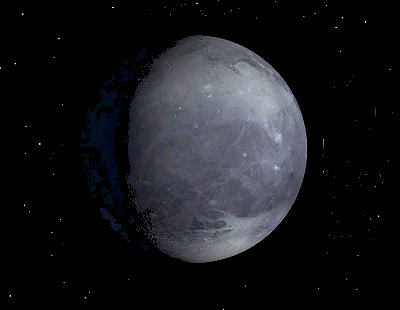
if base on it,the 12 planets in our Solar System will be Mercury, Venus, Earth, Mars, Ceres, Jupiter, Saturn, Uranus, Neptune, Pluto, Charon and 2003 UB313.
随着科学技术发展,物质决定意识,9大行星概念从我们脑中抹去,其行星概念也需更新,不是9大,也不是12大行星,现在叫8大经典行星。
For more: http://www.iau.org/


